See prices From 123 EUR · Free cancellation available
Contents
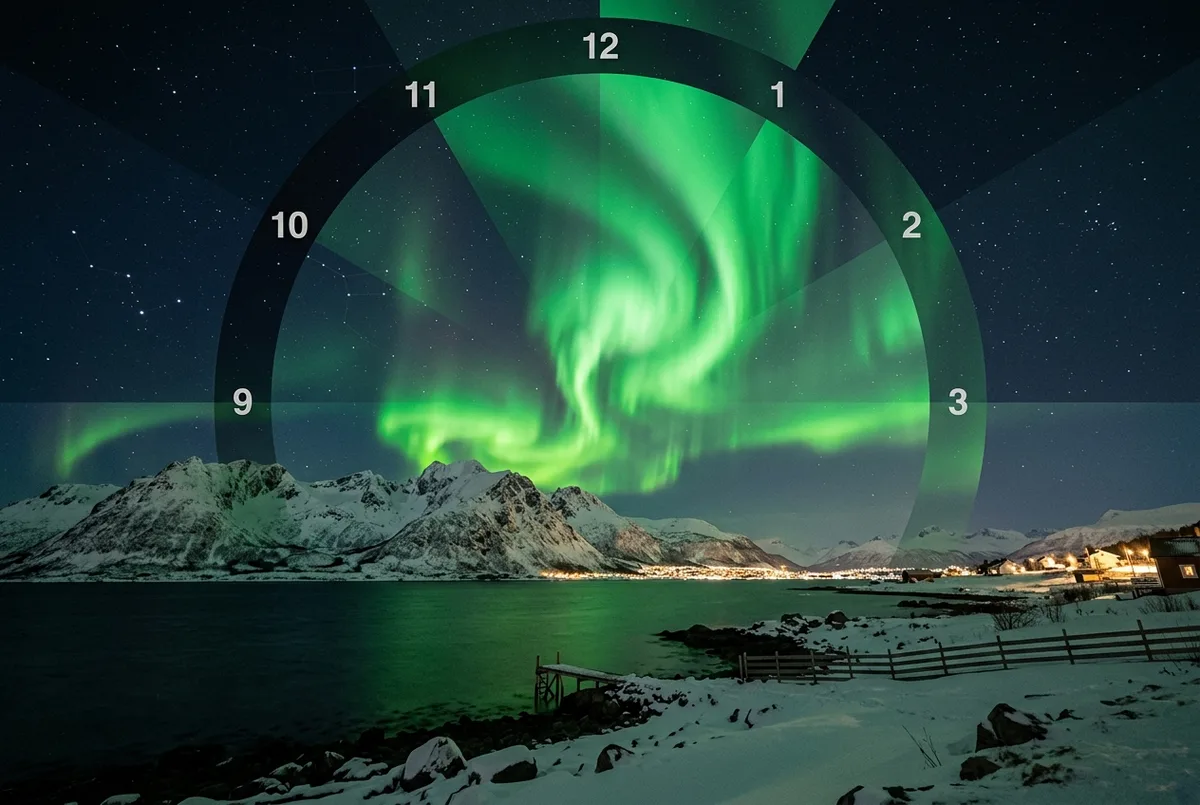
The best time to see the northern lights actually answers two different questions at once: what time of night, and what time of year. The nightly window runs roughly from 10pm to 2am local time, when the sky is at its darkest, and the seasonal window runs from September through April, when nights across the aurora belt are long enough for a genuine dark-sky chase. Here is what I would actually do with both answers in hand: book an evening northern lights chase that starts before 8pm and is free to run past midnight, rather than a short fixed slot, and plan your actual trip dates somewhere in the middle of that September-to-April season rather than at either edge. This guide covers the nightly timing question first, then the seasonal one, with a look at how the two shift slightly by destination.
What Time Does the Aurora Typically Appear at Night?
The aurora is most commonly seen between roughly 10pm and 2am local time, though it can technically appear any time it is fully dark, since that window is simply when geomagnetic activity and a dark sky most often line up together.
I would not treat 10pm to 2am as a strict rule, though. I would rather book a tour that departs in the early evening and stays out as long as needed, since a good guide watches live conditions rather than a clock, and some of the strongest displays operators report happen well outside that core window. A fixed early return time is the bigger risk to your odds than the specific hour you start.
Check prices & dates
Ready to visit?
Book your tickets in advance: popular time slots sell out.
Is There a Best Time Tonight, or Does It Change Every Night?
It genuinely changes every night. Cloud cover, solar wind conditions and the moon’s brightness all shift daily, which is exactly why every real tour on this site is forecast-led rather than built around a fixed nightly schedule.
I would not trust a generic “best time tonight” claim from any source that is not looking at that specific night’s forecast. This is the entire reason a guided tour has a real edge over trying to guess on your own: the guide is checking live cloud radar and solar activity data on the day, not relying on a general rule of thumb that applies most nights but not necessarily yours.
What Season Gives You the Best Overall Odds?
The core season runs from roughly late August through mid-April, with the darkest, longest nights falling between October and March, when most destinations in the aurora belt get several genuinely dark hours every night rather than just a couple.
I would lean toward the middle of that window, November through February, if your travel dates are flexible. The very edges of the season, late August or early April, still work, but shorter nights mean less time for a chase to succeed if the first few hours are cloudy. I would rather have a wide overnight window to work with than a narrow one, even if it means slightly colder temperatures.
Does a Full Moon Ruin Your Chances of Seeing the Aurora?
A bright full moon washes out fainter displays the same way city light pollution does, though it does not erase a genuinely strong aurora the way heavy cloud cover does.
I would not cancel or reschedule a trip purely because a full moon falls during your travel dates. A strong display still shows up clearly under a full moon, and a moonlit landscape can actually make for a more atmospheric photo, since you get some ambient light on the foreground instead of pure blackness. What I would do is treat a new-moon week as a small bonus if your dates are flexible enough to choose, rather than something worth rearranging a whole trip around. Cloud cover and solar activity both matter far more to your actual odds on any given night than where the moon happens to sit in its cycle.
Does December’s Polar Night Actually Make It the Best Month?
For destinations far enough north, like Tromso or Rovaniemi, December can bring true polar night, when the sun does not rise above the horizon at all, giving guides close to continuous darkness to work with.
I would call this a genuine advantage rather than just a curiosity. More dark hours per night simply gives a forecast-led guide more room to find a gap in the clouds somewhere in the region. I would not chase December specifically if it means fighting for flights and hotel availability during the busiest holiday weeks, though; late November or January offer a similar dark-hours advantage with less competition for bookings and generally lower prices on flights and accommodation as well.
How Does the Best Time Differ by Destination?
Destination
Nightly window
Strongest months
Note
Norway (Tromso)
Roughly 6pm to 1am
December to February
Polar night gives very long dark hours
Alaska (Fairbanks)
Roughly 10pm to 2am
November to March
Dry interior climate means fewer persistent clouds
Iceland (Reykjavik)
Roughly 9pm to 1am
October to March
Coastal weather is the most changeable of the four
Lapland (Finland)
Roughly 6pm to 1am
November to February
Arctic Circle location gives long polar-night nights
Should You Book Around a Solar Activity Forecast Instead of a Season?
Not primarily, no. I would pick your travel dates around your own schedule and the general season first, then treat any specific solar-activity forecast as a bonus rather than something to plan an entire trip around.
Solar activity forecasts more than a few days out are genuinely unreliable, and timing a trip around a predicted solar maximum months in advance is a common mistake, since that specific week can just as easily turn out cloudy anyway. A wide, flexible booking window within the September-to-April season does more for your real odds than chasing a specific solar forecast ever will. Once you land, a same-day or next-day forecast is a different story and genuinely worth checking, since that is the timeframe where solar and cloud data actually becomes reliable enough to plan an evening around.
Is Late Evening or Early Morning Better for a First-Time Visitor?
Early evening through midnight is the more practical choice for most first-time visitors, since it does not require staying up until the early hours after an already long travel day.
I would still keep the door open for a display that develops later, though. If your guide’s forecast points to a stronger chance after midnight, I would push through the tiredness rather than heading back early, since that is often exactly the kind of night that produces the display people remember for years. My guide to whether a northern lights tour is worth it covers this tradeoff between comfort and odds in more depth.
My Honest Recommendation on Timing Your Trip
If I were planning a trip purely around timing, I would pick a week in December or January, book a tour that starts in the early evening and has no fixed early return time, and give myself at least two separate nights out rather than relying on a single evening.
I would not overthink the exact hour beyond that. The season and the destination’s latitude do far more work than the specific clock time you step outside, and a guide watching that night’s live conditions will always beat a traveler trying to guess the “best hour” from a generic online rule. → See current availability
Frequently Asked Questions
What time do the northern lights usually appear?
Most commonly between 10pm and 2am local time, though a genuinely active display can appear any time it is fully dark. A good guide watches live conditions rather than a fixed clock.
What is the best month to see the northern lights?
I would aim for November through February across most of the aurora belt, since these months combine long dark nights with a wide chance of clear sky somewhere in the region.
Does the time of year matter more than the time of night?
Both matter, but season sets the ceiling on how many dark hours you have to work with each night, so I would prioritize picking the right months first.
Should I stay out past midnight if the sky looks clear?
Yes, if your guide’s forecast supports it. Some of the strongest displays happen after midnight, and a fixed early return time can cost you exactly the window when conditions peak.
Is there a single best time tonight I can rely on for any destination?
No. Conditions shift nightly with cloud cover and solar activity, which is why every real tour on this site is forecast-led rather than built around one fixed nightly schedule.